

Robugen GmbH
Antihydral 130 mg/g ointment for complaints in the throat and pharynx 70 g
Antihydral 130 mg/g ointment for complaints in the throat and pharynx 70 g
Couldn't load pickup availability
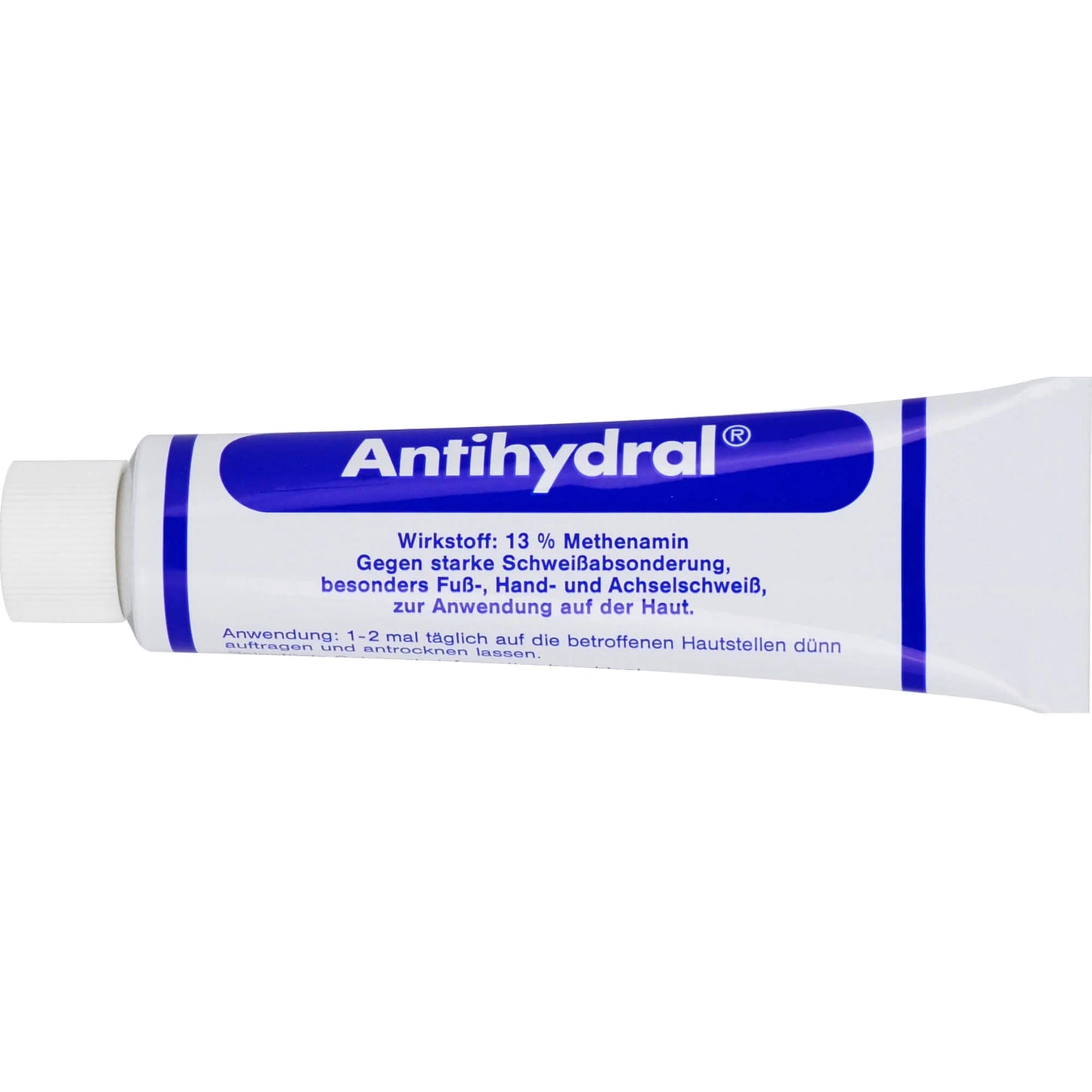
Antihydral ointment. Active ingredient: Methenamine. Indications: for excessive sweating, especially of the feet, hands, and armpits.
For risks and side effects, read the package leaflet and ask your doctor or pharmacist.
PACKAGE LEAFLET: INFORMATION FOR THE USER
Antihydral ointment
Active ingredient: 13% Methenamine
Read the entire package leaflet carefully, as it contains important information for you. This medicine is available without a prescription. However, to achieve the best possible treatment success, Antihydral must be used as directed.
- Keep the package leaflet. You may want to read it again later.
- Ask your doctor or pharmacist if you need more information or advice.
- If your symptoms worsen or do not improve, you should definitely see a doctor.
- If any of the listed side effects become serious, or if you notice any side effects not listed in this leaflet, please inform your doctor or pharmacist.
This package leaflet contains:
- WHAT IS ANTIHYDRAL AND WHAT IS IT USED FOR?
- WHAT DO YOU NEED TO KNOW BEFORE USING ANTIHYDRAL?
- HOW IS ANTIHYDRAL USED?
- WHAT SIDE EFFECTS ARE POSSIBLE?
- HOW SHOULD ANTIHYDRAL BE STORED?
- MORE INFORMATION
1. WHAT IS ANTIHYDRAL AND WHAT IS IT USED FOR?
Antihydral is an ointment for application to the skin and is used for excessive sweating, especially of the feet, hands, and underarms.
2. WHAT DO YOU NEED TO KNOW BEFORE USING ANTIHYDRAL?
Antihydral must not be used if:
- if you are hypersensitive to formaldehyde or any of the other ingredients of Antihydral.
- on weeping or blistered skin areas.
- in the facial area.
When using Antihydral with other medicines:
Please inform your doctor or pharmacist if you are taking/using or have recently taken/used any other medicines, including those obtained without a prescription. No interactions have been reported to date.
Pregnancy and breastfeeding:
Due to insufficient data, you should not use this medicine during pregnancy. Do not apply Antihydral to the breast while breastfeeding.
Driving and operating machinery:
No special precautions are necessary.
3. HOW TO USE ANTIHYDRAL:
Always use Antihydral exactly as described in this leaflet. Please check with your doctor or pharmacist if you are not sure. Apply Antihydral thinly to the affected areas of skin once or twice a day and allow the paste to dry. After a few days, perspiration usually decreases, and Antihydral can then be used less frequently, as needed. If the skin becomes too dry and chapped during treatment, a greasy ointment should be applied temporarily. The skin can be cleansed with water before each new application of Antihydral. The duration of treatment will be determined by your doctor. Please talk to your doctor or pharmacist if you feel that the effect of this medicine is too strong or too weak.
If you have used more Antihydral than you should:
No cases of poisoning are known to date, nor are any expected. In case of an overdose, side effects may be intensified. If you experience any side effects that significantly affect you or that are not listed in this leaflet, please contact your doctor immediately so that they can take the necessary measures without delay.
What should you do if you have used too little Antihydral or have forgotten to apply it?
Do not apply a double dose next time, but continue the application as prescribed by your doctor or as described in this leaflet.
4. POSSIBLE SIDE EFFECTS
Like all medicines, Antihydral can have side effects.
| The following categories are used as a basis for the frequency data on side effects: | |
| Very common: | more than 1 in 10 treated patients |
| Frequently: | 1 to 10 treated patients out of 100 |
| Occasionally: | 1 to 10 treated out of 1,000 |
| Rarely: | 1 to 10 treated out of 10,000 |
| Very rare: | less than 1 in 10,000 treated |
| Not known: | Frequency cannot be estimated based on the available data. |
Rarely, methenamine can cause skin irritation or hypersensitivity reactions when applied topically. Eczema or skin rashes may occur in people with a formaldehyde contact allergy.
Reporting of side effects:
If you experience any side effects, talk to your doctor or pharmacist. This includes any possible side effects not listed in this leaflet. You can also report side effects directly to the Federal Institute for Drugs and Medical Devices, Dept. Pharmacovigilance, Kurt-Georg-Kiesinger-Allee 3, D-53175 Bonn, Germany, website: www.bfarm.de. By reporting side effects, you can help provide more information on the safety of this medicine.
5. HOW TO STORE ANTIHYDRAL?
Keep out of the sight and reach of children. Close the tube tightly after use to prevent the contents from drying out. The expiry date of this pack is printed on the outside of the carton and on the crimp of the tube. Do not use the pack after this date. Once opened, Antihydral is stable until the printed expiry date.
6. FURTHER INFORMATION
What Antihydral contains:
Antihydral contains the active ingredient methenamine in a non-greasy, drying ointment base. 100 g of ointment contains 13 g of methenamine. The other ingredients are talc, purified water, zinc oxide, white clay, glycerol, carmellose sodium, colorant E 172, and flavoring.
What Antihydral looks like and contents of the pack:
Antihydral is a skin-colored ointment and is available in packs of 25 g and 70 g.
Pharmaceutical company and manufacturer:
Robugen GmbH Pharmaceutical Factory
Alleenstraße 22-26
73730 Esslingen
Tel.: +49 711 / 136 30-0
Fax: +49 711 / 36 74 50
Email: info@robugen.de
Internet: www.robugen.de
(Apo) Usually ship out within 3-5 business days