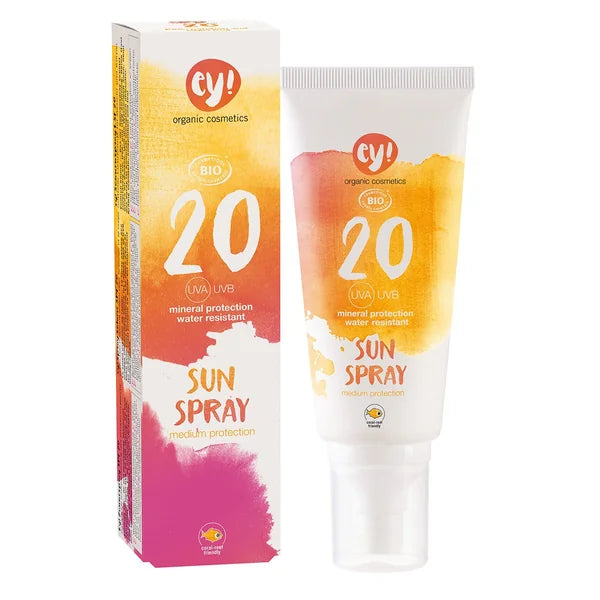

100% natural sunscreen spray with SPF 20 from the new Ey! line from the German manufacturer Eco Cosmetics will provide your skin with much-needed protection from the sun's rays. It is unique in that it contains no water , but high-quality vegetable oils (olive, jojoba, rapeseed). This selected combination cares for your skin and prevents it from drying out. It is easy to apply and spread. It is also suitable for use on the face and is waterproof .
Shake it thoroughly before use!
Of course, 100% natural mineral filters for immediate protection against UVA and UVB sunlight are included . Full UVA protection is provided by a special variant of titanium dioxide, UV Titanium Dioxide, which is specially formulated for these purposes.
Sunscreens from the Ey! line have a gentle composition , thanks to which they are, among other things, also safe for coral reefs . So you can not only sunbathe, but also swim without a guilty conscience - you are not harming yourself or the nature around you. The composition is also unique in that it is very simple and of high quality.
Be careful, it may stain clothes.
No chemistry
It does not contain problematic components of conventional sunscreens such as chemical filters, artificial fragrances, petroleum derivatives, paraffin or silicone, nanotechnology, aluminum salts, parabens or PEGs or GMOs.
Unlike conventional chemical sunscreens, it poses no danger to aquatic organisms.
How do natural sunscreens actually work and how do you handle them?
Natural sunscreens use compounds that can be obtained from minerals to protect against UV radiation. The most common are titanium dioxide (TiO2) and zinc oxide (ZnO), but manufacturers are also coming up with new-generation mineral filters. Mineral filters do not irritate or cause allergies to the skin and are safer than conventionally used chemical filters. They work on a purely physical principle - they create a thin layer on the skin that reflects UV radiation.
Physical (mineral) filters, which are used in truly natural sunscreens, act as a barrier that reflects most of the sun's radiation. They are designated by the FDA as the only generally effective and safe UV filters .
When it comes to protection against UVA and UVB radiation, always follow the label on the product packaging. If it says UVA in a circle, then you can be sure of full protection, as manufacturers must pass tests to be able to put this label on the packaging.
How to choose a sunscreen in the store that will serve you and not harm you? We have prepared a guide for you on the blog.
Avoid regular sunscreens
Most sunscreens on supermarket or pharmacy shelves are nothing more than a nest of toxins. They contain parabens (preservatives), often aluminum, artificial fragrances (the most common allergens) and chemical filters (e.g. oxybenzone, benzophenone, oxyphenone and others). Be careful with chemical filters. Some only protect against UVB radiation, but not against UVA (e.g. octinoxate, octisalate, cinoxate, aminobenzoic acid, amiloxate or enzacamene). So always look on the box to see if it also says protection against UVA radiation.
For better spreadability, manufacturers reduce the filter particles from micro to nano. Nanoparticles are already so small (less than 0.1 nm) that they can pass through the skin and cause problems in the body. The aforementioned oxybenzone, contained in creams as a chemical UV filter, can penetrate the skin into the blood in up to one third of its content. In addition, chemical filters produce free radicals that damage cells and can also cause hormonal imbalances.
Regular creams are also completely unsuitable for aquatic life. Oxybenzone gets into water (whether sewage or marine) by showering, washing clothes that contain oxybenzone (functional underwear or color fixation against fading). It remains up to 20% even in purified drinking water, as wastewater treatment plants are not able to completely filter out this substance. It also contributes to marine toxicity such as widespread coral extinction, causing reef bleaching, and it is simply advisable to avoid them.
Are you more interested in the issue of sunbathing? Do you want to learn how to distinguish SPF, what it is, and much more that you probably won't read anywhere else? We have prepared a tanning guide for you that will explain everything to you.