
Infectopharm
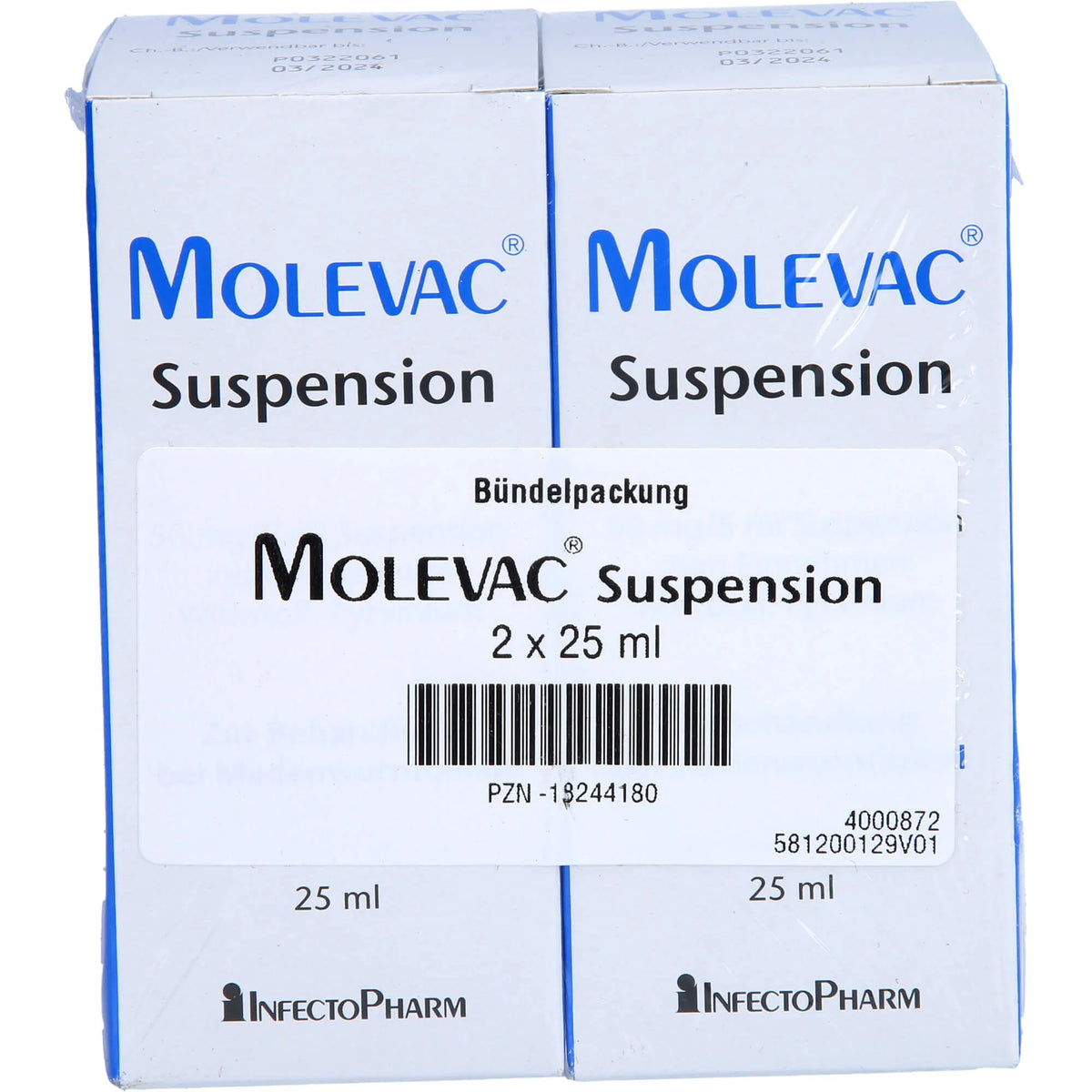
Molevac Suspension, 25 ml solution
Molevac Suspension, 25 ml solution
Couldn't load pickup availability
Molevac oral suspension. Active ingredient: Pyrvinium. Indications: For the treatment of threadworm infestation (oxyuriasis). Warning: Contains sucrose (sugar), benzoic acid, benzyl alcohol, propylene glycol, sodium, benzoic acid, benzyl alcohol, and propylene glycol.
For risks and side effects, read the package leaflet and ask your doctor or pharmacist.
PACKAGE LEAFLET: INFORMATION FOR THE USER
Molevac oral suspension Active
ingredient: Pyrvinium
Read the entire package leaflet carefully before you start taking this medicine because it contains important information. Always take this medicine exactly as described in this package leaflet or exactly as your doctor or pharmacist has told you.
- Keep the package leaflet. You may want to read it again later.
- Ask your pharmacist if you need more information or advice.
- If you experience any side effects, talk to your doctor or pharmacist. This includes any possible side effects not listed in this leaflet. See section 4.
- If your symptoms worsen or do not improve, you should definitely see a doctor.
What this leaflet contains:
- WHAT IS MOLEVAC AND WHAT IS IT USED FOR?
- WHAT SHOULD YOU CONSIDER BEFORE TAKING MOLEVAC?
- HOW SHOULD MOLEVAC BE TAKEN?
- WHAT SIDE EFFECTS ARE POSSIBLE?
- HOW SHOULD MOLEVAC BE STORED?
- PACKAGE CONTENTS AND FURTHER INFORMATION
1. WHAT IS MOLEVAC AND WHAT IS IT USED FOR?
Molevac is a medication for treating threadworm infestations (oxyuriasis). Molevac can be used in children from 1 year of age, adolescents, and adults. The active ingredient in Molevac, pyrvinium, is specifically effective against threadworms (pinworms). The worm-killing effect is based on Molevac disrupting the metabolism of the threadworms.
2. WHAT SHOULD YOU KNOW BEFORE TAKING MOLEVAC?
Molevac must not be taken:
- if you are allergic to the active ingredient pyrvinium, benzyl alcohol or any of the other ingredients of this medicine listed in section 6.
- in case of liver damage.
- in inflammatory bowel diseases.
- in cases of impaired kidney function.
Warnings and precautions:
Please talk to your doctor or pharmacist before taking Molevac. Molevac will turn your stool bright red. This is not a sign of illness; it simply indicates that the active ingredient has passed through the gastrointestinal tract. The active ingredient in Molevac, pyrvinium, can stain fabrics, for example, through vomiting or red stools. This staining is not washable. In cases of worm infestation, family members or other close contacts are often also affected. Ask your doctor or pharmacist whether these contacts should also be treated. Pay attention to personal hygiene and thoroughly clean your living areas (home, workplace) and clothing.
Children:
The safety and efficacy of Molevac in children under 1 year of age have not yet been established. Therefore, Molevac is not suitable for this age group.
Taking Molevac with other medicines:
Tell your doctor or pharmacist if you are taking, have recently taken, or might take any other medicines. No interactions with other medicines have been observed to date.
Pregnancy, breastfeeding, and fertility:
If you are pregnant or breastfeeding, think you may be pregnant, or are planning to have a baby, ask your doctor or pharmacist for advice before taking this medicine.
Pregnancy:
You should only take Molevac during pregnancy if it is absolutely necessary, taking into account the risks to mother and child, for example, because other active ingredients cannot be taken. When using Molevac during pregnancy, the dose should be based on your pre-pregnancy body weight (see also section 3. How to take Molevac).
Breastfeeding:
For safety reasons, breastfeeding mothers should pump and discard their milk while using Molevac.
Women of childbearing age:
Women of childbearing age should use a reliable method of contraception during treatment with Molevac, as the potential risks of using Molevac during pregnancy are unknown.
Driving and operating machinery:
No special precautions are necessary.
Molevac contains sucrose (sugar), benzoic acid, benzyl alcohol, propylene glycol, and sodium.
Please consult your doctor before taking Molevac if you know you have an intolerance to certain sugars. 5 ml of suspension contains 1.15 g of sucrose (sugar). If you are on a diabetic diet, please take this into account.
This medicine contains 5 mg of benzoic acid, 0.2 mg of benzyl alcohol, and 662 mg of propylene glycol per 5 ml of suspension.
If your child is under 5 years old, talk to your doctor or pharmacist before giving them this medicine, especially if your child is also taking other medicines containing propylene glycol or alcohol.
Do not take this medicine if you are pregnant or breastfeeding unless advised by your doctor. Your doctor may carry out additional tests while you are taking this medicine. Do not take this medicine if you have liver or kidney disease unless advised by your doctor. Your doctor may carry out additional tests while you are taking this medicine. This medicine contains less than 1 mmol (23 mg) sodium per 5 ml of suspension, i.e., it is essentially sodium-free.
3. HOW TO TAKE MOLEVAC?
Always take this medicine exactly as described in this leaflet or as your doctor or pharmacist has told you. Check with your doctor or pharmacist if you are not sure.
Dosage:
Molevac is usually given as a single dose.
Unless otherwise prescribed by your doctor, the usual dose is:
Children from 1 year of age, adolescents, and adults receive 5 ml of Molevac (corresponding to 50 mg pyrvinium) per 10 kg of body weight. The maximum dose for children, adolescents, and adults (even if they weigh more than 80 kg) is 40 ml of Molevac (corresponding to 400 mg pyrvinium), see dosage table. If the effect is insufficient, do not increase the amount of medicine, but repeat the treatment.
Dosage table:
| Age approx. (years) | Body weight approx. (kg) | Amount of medicine (single dose) in ml |
| Children or young people 1-3 | Oct 14 | 5 - 7.5 |
| Children or young people 4-5 | 15 - 19 | 7.5 - 10 |
| Children and young people aged 6-9 | 20 - 29 | 10 to 15 |
| Children or young people aged 10-12 | 30 - 39 | 15 - 20 |
| Children and young people aged 13-14 | 40 - 49 | 20 - 25 |
| Children or young people aged 15-16 | 50 - 59 | 25 - 30 |
| Adult | 60 - 69 | 30 - 35 |
| Adult | 70 - 79 | 35 - 40 |
| Adult | 80 (or more) | 40 |
Use in children and adolescents:
The dosage for children from 1 year of age and adolescents can be found in the dosage table.
Method of administration:
Molevac can be taken with or without food. If you need to take a larger amount of suspension, it is best to divide the dose into three portions: before, during, and after meals. In children, Molevac suspension can be diluted with water or other liquids (fruit juice). Shake the suspension before use.
Pregnant women:
When using Molevac during pregnancy, the dosage should be based on the body weight before pregnancy. Regarding possible risks of using Molevac during pregnancy, see section 2 under Pregnancy, Breastfeeding and Fertility.
Patients with impaired kidney function:
Molevac must not be used in patients with impaired kidney function (see section 2 under Molevac must not be taken).
Patients with impaired liver function:
Molevac must not be used in patients with liver damage (see section 2 under Molevac must not be taken).
Elderly patients (over 65 years):
Unless there is impaired liver or kidney function, no special precautions are necessary.
Duration of use:
Repeat the treatment with Molevac in the same way after 2 to 4 weeks.
If you have taken more Molevac than you should:
The side effects of Molevac may be intensified (see also section 4: Possible side effects). If you experience signs of poisoning after taking Molevac, please consult a doctor immediately. They may perform gastric lavage or administer activated charcoal.
If you forget to take Molevac:
You can easily take the missed dose on the same day. However, you should always take the total amount of Molevac stated in this leaflet.
If you have any further questions about taking this medicine, ask your doctor or pharmacist.
4. POSSIBLE SIDE EFFECTS
Like all medicines, this medicine can cause side effects, although not everybody gets them.
| The following frequency data is used as a basis for assessing side effects: | |
| Very common: | more than 1 in 10 treated patients |
| Frequently: | 1 to 10 treated patients out of 100 |
| Occasionally: | 1 to 10 treated out of 1,000 |
| Rarely: | 1 to 10 treated out of 10,000 |
| Very rare: | less than 1 in 10,000 treated |
| Not known: | Frequency cannot be estimated based on the available data. |
Diseases of the nervous system:
- Occasionally: headaches.
- Very rare: cramps.
Diseases of the ear and labyrinth:
- Very rare: dizziness.
Diseases of the respiratory tract, chest cavity and mediastinum:
- Very rare: temporary internal swelling of the larynx (laryngeal edema).
Diseases of the gastrointestinal tract:
- Common symptoms: abdominal pain, nausea, vomiting.
- Occasionally: Diarrhea.
- Rare: stomach cramps, bloating, constipation.
- Very rare: inflammation of the oral mucosa (stomatitis).
Diseases of the skin and subcutaneous tissue
- Very rare: allergic skin reactions with and without itching, such as hives with blisters and wheals (urticaria), photosensitivity, skin rashes, skin bleeding (purpura) and swelling of the skin and mucous membranes (angioedema).
Benzyl alcohol can cause allergic reactions.
Reporting of side effects:
If you experience any side effects, talk to your doctor or pharmacist. This includes any possible side effects not listed in this leaflet. You can also report side effects directly to the Federal Institute for Drugs and Medical Devices, Dept. Pharmacovigilance, Kurt-Georg-Kiesinger-Allee 3, D-53175 Bonn, Germany, website: www.bfarm.de. By reporting side effects, you can help provide more information on the safety of this medicine.
5. HOW TO STORE MOLEVAC?
Keep this medicine out of the sight and reach of children. Do not use this medicine after the expiry date which is stated on the label and carton after "EXP". The expiry date refers to the last day of that month. Never dispose of medicines via wastewater (e.g., down the toilet or sink). Ask your pharmacist how to dispose of medicines no longer required. By doing so, you are contributing to environmental protection. Further information can be found at www.bfarm.de/arzneimittelentsorgung.
6. CONTENTS OF THE PACK AND OTHER INFORMATION
What Molevac contains:
The active ingredient is pyrvinium. 5 ml of suspension contains 75.25 mg pyrvinium embonate (equivalent to 50 mg pyrvinium base). The other ingredients are: benzoic acid, cherry flavor (contains benzyl alcohol), methylcellulose, sodium hydroxide, sodium phosphate dodecahydrate, poloxamer 188, propylene glycol, saccharin sodium dihydrate, sucrose, hydrochloric acid 10%, sorbitan monolaurate (Ph. Eur.), purified water.
What Molevac looks like and contents of the pack:
Red, viscous suspension with a cherry scent. 25 ml of suspension with measuring cup.
(Apo) Usually ship out within 3-5 business days