

Pascoe
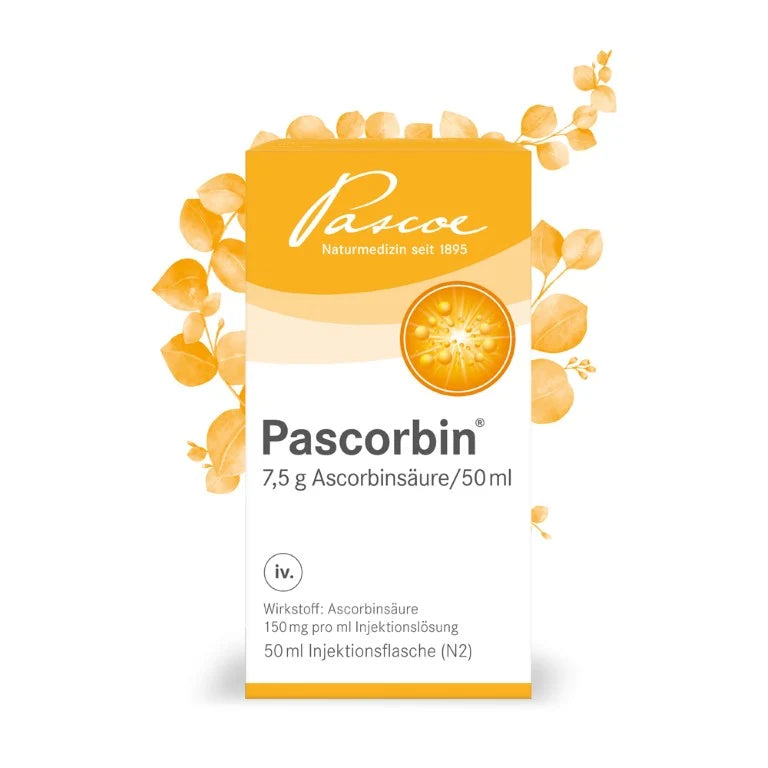
Pascoe Pascorbin injection solution for vitamin C deficiency, 50 ml
Pascoe Pascorbin injection solution for vitamin C deficiency, 50 ml
Couldn't load pickup availability
Pascorbin. Active ingredient: Ascorbic acid 150 mg per ml solution for injection. Indications: Treatment of clinical vitamin C deficiency states that cannot be corrected by diet or oral supplementation, and in cases of methemoglobinemia in childhood.
For risks and side effects, read the package leaflet and ask your doctor or pharmacist.
PACKAGE LEAFLET: INFORMATION FOR THE USER
Pascorbin
Active ingredient: Ascorbic acid 150 mg per ml solution for injection
For use in adults and children.
Read the entire package leaflet carefully before you start using this medicine because it contains important information for you. Always use this medicine exactly as described in the package leaflet or exactly as your doctor or pharmacist has told you.
- Keep the package leaflet. You may want to read it again later.
- Ask your pharmacist if you need more information or advice.
- If you experience any side effects, talk to your doctor or pharmacist. This includes any possible side effects not listed in this leaflet. See section 4.
- If your symptoms worsen or do not improve, you should definitely see a doctor.
What this leaflet contains:
- WHAT IS PASCORBIN AND WHAT IS IT USED FOR?
- WHAT SHOULD YOU CONSIDER BEFORE USING PASCORBIN?
- HOW IS PASCORBIN USED?
- WHAT SIDE EFFECTS ARE POSSIBLE?
- HOW SHOULD PASCORBIN BE STORED?
- PACKAGE CONTENTS AND FURTHER INFORMATION
1. WHAT IS PASCORBIN AND WHAT IS IT USED FOR?
Ascorbic acid (vitamin C) is a water-soluble vitamin. Pascorbin is used for:
- For the treatment of clinical vitamin C deficiency states that cannot be corrected through diet or oral substitution.
- In cases of methemoglobinemia in childhood.
2. WHAT SHOULD YOU KNOW BEFORE USING PASCORBIN?
Pascorbin must not be used in the following cases:
The following describes when Pascorbin may only be used under certain conditions and with particular caution. Please consult your doctor about this. This also applies if these conditions applied to you in the past. Pascorbin should only be used after consulting your doctor in cases of oxalate kidney stones and certain diseases in which too much iron is stored in the body (thalassemia, hemochromatosis, sideroblastic anemia).
Warnings and precautions:
Special note for diabetics:
After parenteral administration of ascorbic acid, the detection of glucose in the blood is impaired. Intravenous injection of high doses of Pascorbin can lead to acute kidney failure due to kidney stones through the precipitation of calcium oxalate crystals in the kidney. This has been observed even at doses of 1.5–2.5 g. Patients with pre-existing kidney impairment (renal insufficiency) are particularly at risk. Adequate fluid intake (approximately 1.5 to 2 liters per day) should be ensured. In patients with recurrent kidney stones, the daily vitamin C dose should not exceed 100 to 200 mg. Patients with severe or end-stage renal disease (dialysis patients) should not receive more than 50 to 100 mg daily. In patients with erythrocyte glucose-6-phosphate dehydrogenase deficiency (an inherited disorder of red blood cell metabolism), severe hemolysis (destruction of red blood cells) has been observed in isolated cases with high doses of vitamin C (more than 4 g daily). Therefore, exceeding a daily dose of 100–500 mg of ascorbic acid should be avoided. In patients with known respiratory problems (especially due to impaired respiratory function, such as asthma, chronic bronchitis, or smoker's cough), acute respiratory distress may occur in isolated cases when treated with high doses (7.5 g and above) of Pascorbin. It is therefore recommended to start treatment with lower doses in these patients. Pascorbin must not be mixed with drugs whose efficacy is reduced by chemical reduction.
Children:
- In children under 12 years of age, the intravenous administration of ascorbic acid should not exceed 5-7 mg/kg body weight per day as part of parenteral nutrition.
- In the treatment of methemoglobinemia in childhood, a daily dose of 100 mg ascorbic acid/kg body weight should not be exceeded.
Elderly patients:
Ensure adequate fluid intake (approx. 1.5 to 2 liters per day).
Note:
After administration of gram doses, the ascorbic acid concentration in the urine can rise to such an extent that the measurement of various clinical-chemical parameters (glucose, uric acid, creatinine, inorganic phosphate) is disrupted and distorted.
Use of Pascorbin with other medicinal products:
The effects of the following drugs or drug classes may be influenced by concurrent treatment with Pascorbin. Pascorbin can chemically alter other drugs (due to its high redox potential); therefore, compatibility with other drugs must be checked on a case-by-case basis when administered concurrently. Ascorbic acid may affect the action of anticoagulants. The simultaneous administration of ascorbic acid and fluphenazine leads to a decreased plasma concentration of fluphenazine, while the simultaneous use of ascorbic acid and acetylsalicylic acid leads to decreased acetylsalicylic acid excretion and increased ascorbic acid excretion in the urine. Salicylates inhibit the uptake of ascorbic acid into leukocytes (white blood cells) and thrombocytes (platelets). During chemotherapy, higher doses of vitamin C should be administered at a different time (1-3 days, depending on the half-life of the chemotherapeutic agent) because clinical data on possible interactions are lacking. Please inform your doctor or pharmacist if you are taking/using or have recently taken/used any other medicines, including those obtained without a prescription.
Using Pascorbin with food and drink:
No special precautions are necessary.
Pregnancy and breastfeeding:
Pregnancy:
During pregnancy, the daily dose of ascorbic acid should not exceed 100 to 500 mg.
Breastfeeding:
During breastfeeding, the daily dose of ascorbic acid should not exceed 100 to 500 mg.
Driving and using machines:
No special precautions are necessary.
Pascorbin contains sodium:
One ampoule with 5 ml of solution for injection contains 4.2 mmol (97.2 mg) of sodium, and one vial with 50 ml of solution for injection contains 42.3 mmol (972 mg) of sodium. This should be taken into account by patients who are on a low-sodium diet.
3. HOW TO USE PASCORBIN?
Always use Pascorbin exactly as described in this leaflet. Please ask your doctor or pharmacist if you are not sure. Pascorbin is generally administered by a doctor. Unless otherwise prescribed by your doctor, the usual dose is: Pascorbin is intended for peripheral venous injection. Unless otherwise prescribed, inject 5 ml slowly intravenously daily, up to 50 ml of solution for injection as an additive to an infusion. To prevent vitamin C deficiency during prolonged parenteral nutrition, adults receive 100 to 500 mg of ascorbic acid intravenously per day (corresponding to 0.7 ml to 3.3 ml of Pascorbin). Children receive 5 to 7 mg of ascorbic acid/kg body weight intravenously per day. Methemoglobinemia in childhood: A single intravenous injection of 500 to 1000 mg of ascorbic acid (corresponding to 3.3 ml to 6.6 ml of Pascorbin) is administered. If necessary, the dose should be repeated. A dose of 100 mg/kg body weight per day should not be exceeded.
Method of administration:
Pascorbin is administered slowly intravenously (into the veins) by your doctor or other medical personnel.
Duration of use:
Your doctor will determine the duration of use based on the course of the disease and blood test results.
If you have used more Pascorbin than you should:
Stop using Pascorbin. Other measures are generally not necessary, except in the case of hemolysis or kidney stones (see section Precautions for use and Warnings). If you experience pain in the kidney area or difficulty urinating after a high dose of Pascorbin, contact a doctor immediately.
4. POSSIBLE SIDE EFFECTS
Like all medicines, Pascorbin can cause side effects, although not everyone will experience them.
| The following frequency data is used as a basis for assessing side effects: | |
| Very common: | more than 1 in 10 treated patients |
| Frequently: | 1 to 10 treated patients out of 100 |
| Occasionally: | 1 to 10 treated out of 1,000 |
| Rarely: | 1 to 10 treated out of 10,000 |
| Very rare: | less than 1 in 10,000 treated |
| Not known: | Frequency cannot be estimated based on the available data. |
Possible side effects:
Very rarely, hypersensitivity reactions (e.g., breathing difficulties, allergic skin reactions) have been observed. Very rarely, high doses of ascorbic acid can cause gastrointestinal disturbances (e.g., nausea, vomiting, diarrhea). In isolated cases, short-term circulatory disturbances (e.g., dizziness, nausea, visual disturbances) may occur. In very rare cases, reactions such as chills and fever have been observed in acute infections.
Countermeasures:
Stop the injection or infusion immediately.
Reporting of side effects:
If you notice any side effects, contact your doctor or pharmacist. This also applies to side effects not listed in this leaflet. You can also report side effects directly to the Federal Institute for Drugs and Medical Devices, Dept. Pharmacovigilance, Kurt-Georg-Kiesinger-Allee 3, D-53175 Bonn, Germany, website: www.bfarm.de. By reporting side effects, you can help provide more information on the safety of this medicine.
5. HOW TO STORE PASCORBIN?
Keep this medicine out of the sight and reach of children. Do not use this medicine after the expiry date which is stated on the carton and the vial after "EXP". The expiry date refers to the last day of that month.
Storage conditions:
Do not store ampoules or vials above 25°C. Protect ampoules or vials from light.
Note on shelf life after opening or preparation:
The preservative-free solution for injection is intended for single use only. It must be used immediately after opening the ampoule or vial. Discard any unused portion. Never dispose of medicines via wastewater (e.g., down the toilet or sink). Ask your pharmacist how to dispose of medicines you no longer need. This will help protect the environment. Further information can be found at www.bfarm.de/arzneimittelentsorgung.
6. CONTENTS OF THE PACK AND OTHER INFORMATION
What Pascorbin contains:
The active ingredient is: ascorbic acid. 1 ml of solution for injection contains 150 mg of ascorbic acid.
The other ingredients are: sodium bicarbonate, water for injections.
What Pascorbin looks like and contents of the pack:
Brown ampoules or a brown glass bottle containing a clear, yellowish liquid. Pascorbin is available in packs of 5 ampoules/5 ml, 10 ampoules/5 ml, hospital packs of 100 ampoules/5 ml, 1000 ampoules/5 ml, 50 ml vials, and multipacks of 20 and 60 50 ml vials. Not all pack sizes may be marketed.
(Apo) Usually ship out within 3-5 business days