

Klinge
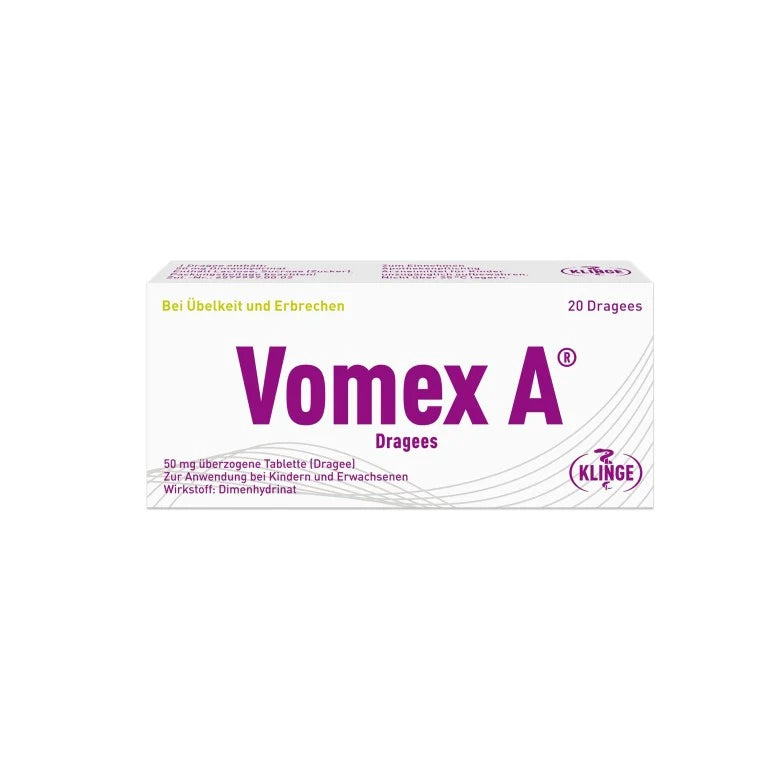
Vomex A dragees, 20 dragees
Vomex A dragees, 20 dragees
Couldn't load pickup availability
Vomex A coated tablets 50 mg. Active ingredient: Dimenhydrinate. Indications: For the prevention and treatment of nausea and vomiting of various origins, especially motion sickness.
For risks and side effects, read the package leaflet and ask your doctor or pharmacist!
PACKAGE LEAFLET: INFORMATION FOR THE USER
Vomex A coated tablets 50 mg for use in children and adults.
Active ingredient: Dimenhydrinate.
Read the entire package leaflet carefully before you start taking this medicine because it contains important information. Always take this medicine exactly as described in this package leaflet or exactly as your doctor or pharmacist has told you.
- Keep the package leaflet. You may want to read it again later.
- Ask your pharmacist if you need more information or advice.
- If you experience any side effects, talk to your doctor or pharmacist. This includes any possible side effects not listed in this leaflet. See section 4.
- If you do not feel better or even feel worse after 14 days, consult your doctor.
What this leaflet contains:
- WHAT ARE VOMEX A DRAGEES AND WHAT ARE THEY USED FOR?
- WHAT SHOULD YOU CONSIDER BEFORE TAKING VOMEX A DRAGEES?
- HOW SHOULD VONEX A DRAGEES BE TAKED?
- WHAT SIDE EFFECTS ARE POSSIBLE?
- HOW SHOULD VOMEX A DRAGEES BE STORED?
- PACKAGE CONTENTS AND FURTHER INFORMATION
1. WHAT ARE VOMEX A DRAGEES AND WHAT ARE THEY USED FOR?
Vomex A coated tablets are an anti-nausea and anti-vomiting medication from the H1 antihistamine group. Vomex A coated tablets are taken for the prevention and treatment of nausea and vomiting of various origins, especially motion sickness. Note: Dimenhydrinate is not suitable for the sole treatment of nausea and vomiting resulting from cancer treatment with chemotherapy (cytostatic therapy). If you do not feel better or even feel worse after 14 days, consult your doctor.
2. WHAT YOU NEED TO KNOW BEFORE TAKING VOMEX A DRAGEES?
Do not take Vomex A coated tablets if:
- if you are allergic to dimenhydrinate, other antihistamines, sunset yellow FCF, Ponceau 4R, azorubine or any of the other ingredients of this medicine listed in section 6,
- in case of an acute asthma attack,
- in glaucoma (narrow-angle glaucoma),
- if you have an adrenal gland tumor (pheochromocytoma),
- if you suffer from a disorder in the production of blood pigment (porphyria),
- in cases of enlarged prostate gland (benign prostatic hyperplasia) with residual urine formation,
- if you suffer from seizures (epilepsy, eclampsia).
Warnings and precautions:
Please talk to your doctor or pharmacist before taking Vomex A coated tablets if you have:
- impaired liver function,
- Cardiac arrhythmias (e.g., rapid heartbeat),
- Potassium or magnesium deficiency,
- slowed heartbeat (bradycardia),
- certain heart conditions (congenital QT syndrome or other clinically significant heart damage, especially coronary artery disease, conduction disorders, arrhythmias),
- simultaneous use of drugs that also prolong the so-called QT interval in the ECG or lead to hypokalemia (see under “Taking Vomex A coated tablets with other drugs”),
- chronic respiratory problems and asthma,
- Narrowing at the exit of the stomach (pyloric stenosis).
Vomex A coated tablets should only be taken in these cases after consulting a doctor.
Children:
Vomex A coated tablets should not be used in children under 6 years of age. Special lower-dose formulations are available for this age group.
Taking Vomex A coated tablets with other medicines:
Inform your doctor or pharmacist if you are taking/using, have recently taken/used, or intend to take/use any other medicines. Taking Vomex A coated tablets at the same time as other centrally acting depressants (medicines that affect the mind, sleeping pills, sedatives, painkillers, and anesthetics) may result in a mutual potentiation of effects. The anticholinergic effects of Vomex A coated tablets (see section 4, "What side effects are possible?") can be unpredictably intensified by the simultaneous administration of other substances with anticholinergic effects (e.g., atropine, biperiden, or certain antidepressants [tricyclic antidepressants]). When Vomex A coated tablets are taken concurrently with so-called monoamine oxidase inhibitors (medicines also used to treat depression), life-threatening paralytic ileus, urinary retention, or an increase in intraocular pressure may develop. Furthermore, a drop in blood pressure and increased impairment of central nervous system and respiratory function may occur. Therefore, Vomex A coated tablets must not be taken concurrently with monoamine oxidase inhibitors. Simultaneous use with medications that also prolong the QT interval on an electrocardiogram (ECG), such as antiarrhythmics (class IA or III), certain antibiotics (e.g., erythromycin), cisapride, antimalarials, antihistamines (allergy medications or medications for stomach/intestinal ulcers), or neuroleptics (medications for specific mental health conditions), or medications that can lead to potassium deficiency (e.g., certain diuretics), should be avoided. Taking Vomex A tablets with medications for high blood pressure may lead to increased drowsiness. The doctor should be informed about the use of Vomex A tablets before allergy tests are performed, as false-negative results are possible. Furthermore, it should be noted that Vomex A tablets may mask hearing loss that may occur during treatment with certain antibiotics (aminoglycosides). Please note that this information may also apply to medications taken recently.
Taking Vomex A coated tablets together with alcohol:
No alcohol should be consumed during treatment with Vomex A coated tablets, as alcohol can unpredictably alter and intensify the effects of Vomex A coated tablets. This will also further impair your ability to drive and operate machinery.
Pregnancy and breastfeeding:
If you are pregnant or breastfeeding, or if you suspect you may be pregnant or are planning to become pregnant, ask your doctor or pharmacist for advice before using this medicine.
Pregnancy:
Dimenhydrinate, the active ingredient in Vomex A coated tablets, can induce premature labor. The safety of using Vomex A coated tablets during pregnancy has not been established. A risk associated with dimenhydrinate cannot be ruled out based on clinical data. You should only take Vomex A coated tablets after consulting your doctor and only if they consider it absolutely necessary.
Breastfeeding:
Dimenhydrinate, the active ingredient in Vomex A coated tablets, passes into breast milk. The safety of using Vomex A coated tablets while breastfeeding has not been established. Since undesirable effects, such as increased restlessness, cannot be ruled out in the breastfed child, you should either not take Vomex A coated tablets while breastfeeding or discontinue breastfeeding while taking Vomex A coated tablets.
Driving and operating machinery:
Drowsiness, memory problems, and reduced concentration can impair your ability to drive or operate machinery. This applies particularly after insufficient sleep, at the start of treatment, when switching medications, and in combination with alcohol (see also Taking Vomex A coated tablets with other medicines/with alcohol).
Vomex A coated tablets contain lactose, sucrose, and glucose:
Therefore, please only take Vomex A coated tablets after consulting your doctor if you know that you have an intolerance to certain sugars.
3. HOW TO TAKE VOMEX A DRAGEES?
Always take this medicine exactly as described in this leaflet or exactly as your doctor or pharmacist has told you. Consult your doctor or pharmacist if you are unsure. The dosage of dimenhydrinate should be based on the patient's body weight. In young children, a single dose may be sufficient to relieve symptoms. Unless otherwise prescribed by the doctor, daily doses of 5 milligrams per kilogram of body weight should not be exceeded. This means that children weighing less than 30 kg should generally not receive more than 2 tablets per day.
The recommended dose is:
- Adults and adolescents over 14 years: 1 - 4 times daily 1 - 2 coated tablets (corresponding to 50 - 400 mg dimenhydrinate), but not more than 8 coated tablets per day (400 mg dimenhydrinate).
- Children aged 6 to 14 years: 1-3 times daily 1 coated tablet (corresponding to 50-150 mg dimenhydrinate), but not more than 3 coated tablets (150 mg dimenhydrinate).
- For children up to 6 years of age, special lower-dose formulations are available.
Method of administration:
For the prevention of travel sickness, the first dose should be taken approximately ½ to 1 hour before the start of the journey. For the treatment of nausea and vomiting, doses should be taken at regular intervals throughout the day. The coated tablets should be swallowed whole with plenty of liquid.
Duration of use:
Unless otherwise prescribed by a doctor, Vomex A coated tablets are intended for short-term use only. If symptoms persist, a doctor should be consulted. After a maximum of 2 weeks of treatment, your doctor should assess whether continued treatment with Vomex A coated tablets is necessary.
If you have taken more Vomex A coated tablets than you should:
Poisoning with dimenhydrinate, the active ingredient in Vomex A coated tablets, can be life-threatening. Children are particularly at risk. In case of an overdose or poisoning with Vomex A coated tablets, a doctor (e.g., a poison control center) should be consulted immediately. An overdose of Vomex A coated tablets is primarily characterized by impaired consciousness, ranging from severe drowsiness to unconsciousness. Other symptoms include: dilated pupils, visual disturbances, rapid heartbeat, fever, hot, flushed skin and dry mucous membranes, constipation, agitation, increased reflexes, and hallucinations. Seizures and respiratory problems are also possible, which, after high doses, can lead to respiratory paralysis and cardiac arrest. The severity of the poisoning and the necessary treatment will be assessed by a doctor.
If you forget to take Vomex A coated tablets:
Do not take a double dose to make up for a missed dose. Instead, continue taking Vomex A coated tablets as directed in this leaflet or as prescribed by your doctor.
If you stop taking Vomex A coated tablets:
Please do not interrupt or stop taking Vomex A coated tablets without first talking to your doctor.
If you have any further questions about taking this medicine, ask your doctor or pharmacist.
4. POSSIBLE SIDE EFFECTS:
Like all medicines, this medicine can cause side effects, although not everybody gets them.
| The following frequency data is used as a basis for assessing side effects: | |
| Very common: | more than 1 in 10 treated patients |
| Frequently: | 1 to 10 treated patients out of 100 |
| Occasionally: | 1 to 10 treated out of 1,000 |
| Rarely: | 1 to 10 treated out of 10,000 |
| Very rare: | less than 1 in 10,000 treated |
| Not known: | Frequency cannot be estimated based on the available data. |
Possible side effects:
Depending on individual sensitivity and the dose taken, the following side effects occur very frequently – especially at the beginning of treatment: drowsiness, dizziness, lightheadedness, and muscle weakness. These side effects can also cause impairment the following day. Commonly occurring anticholinergic side effects include dry mouth, increased heart rate (tachycardia), nasal congestion, visual disturbances, increased intraocular pressure, and difficulty urinating. Gastrointestinal problems (e.g., nausea, stomach pain, vomiting, constipation, or diarrhea) and mood swings have also been observed. Furthermore, especially in children, so-called paradoxical reactions such as restlessness, agitation, insomnia, anxiety, or tremors may occur. Allergic skin reactions, photosensitivity (avoid direct sunlight!), and liver dysfunction (cholestatic jaundice) have also been reported. Blood cell damage can occur in exceptional cases.
Other possible side effects:
With prolonged treatment with dimenhydrinate, the development of drug dependence cannot be ruled out. For this reason, Vomex A coated tablets should only be used for short periods if possible. After prolonged daily use, temporary sleep disturbances may occur if treatment is stopped abruptly. Therefore, in these cases, treatment should be discontinued by gradually reducing the dose. Sunset Yellow FCF, Ponceau 4R, and azorubine may cause allergic reactions.
Reporting of side effects:
If you experience any side effects, talk to your doctor or pharmacist. This includes any possible side effects not listed in this leaflet. You can also report side effects directly to the Federal Institute for Drugs and Medical Devices, Dept. Pharmacovigilance, Kurt-Georg-Kiesinger-Allee 3, D-53175 Bonn, Germany, website: www.bfarm.de. By reporting side effects, you can help provide more information on the safety of this medicine.
5. HOW TO STORE VOMEX A DRAGEES?
Keep this medicine out of the sight and reach of children. Do not use this medicine after the expiry date which is stated on the carton and blister pack after EXP. The expiry date refers to the last day of that month. Storage conditions: Do not store above 25°C.
6. CONTENTS OF THE PACK AND OTHER INFORMATION
What Vomex A coated tablets contain:
The active ingredient is dimenhydrinate. One coated tablet contains 50 mg of dimenhydrinate. The other ingredients are: calcium carbonate, sodium carboxymethyl starch (type A), glucose syrup, gum arabic, lactose monohydrate, macrogol (6000), magnesium stearate, microcrystalline cellulose, sunset yellow FCF, Ponceau 4R, azorubine, sucrose, colloidal silicon dioxide, talc, titanium dioxide, white clay, and montan glycol wax.
(Apo) Usually ship out within 3-5 business days